
Y Computer QM Edition · founding run of 25
Built on Y Combinator's open-source agent platform.
 Y Combinator's software teamqmopen source · MIT · 12.2k starsQM Edition — the local-first build
QM is the multiplayer agent harness Y Combinator's software team built for its own company and released under MIT: one agent floor for a whole team, in Slack and on the web, with per-person isolated workspaces. Upstream, it deploys to a cloud account and calls metered model APIs. The QM Edition is the same core, rebuilt local-first — QM, Postgres and the models all living on one machine we assemble, burn in and benchmark.
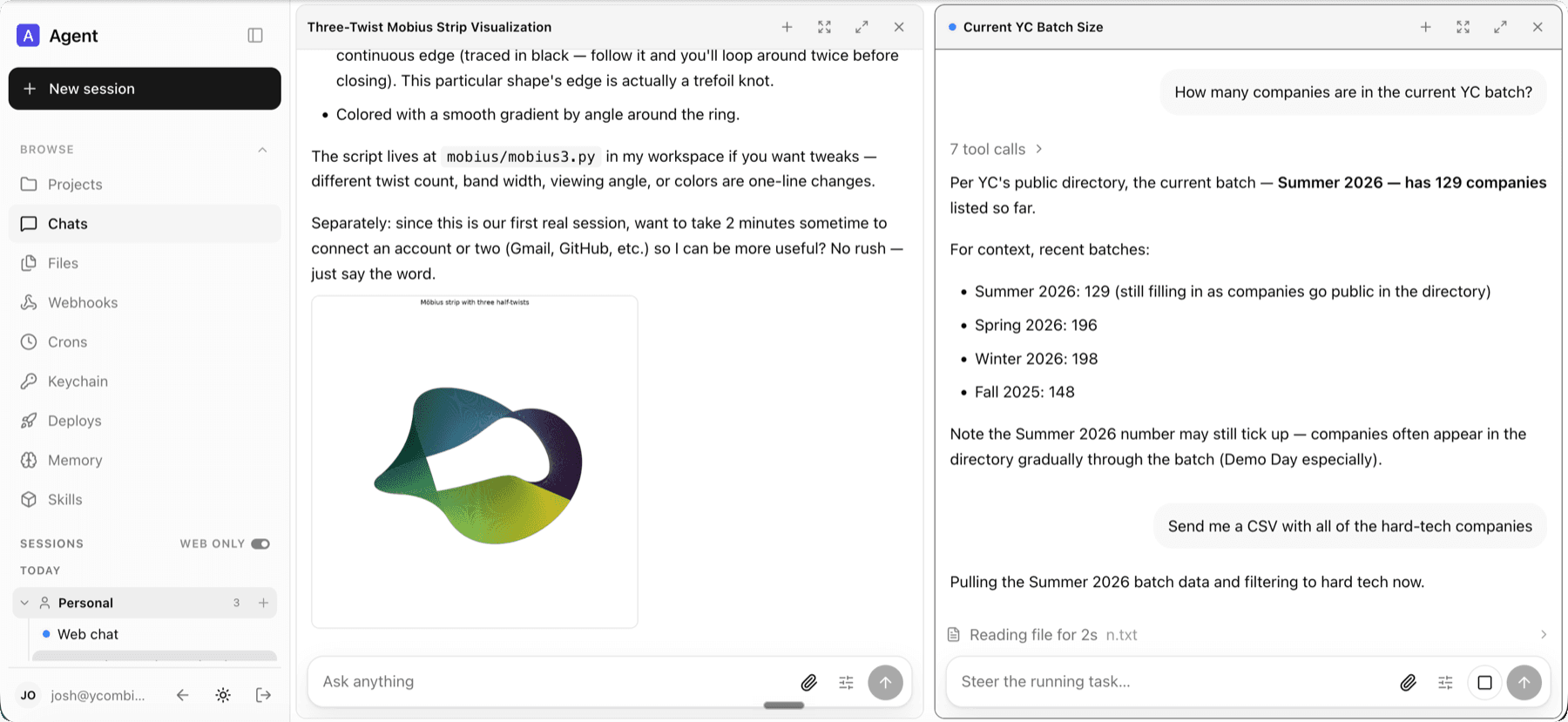
QM's own web UI — unmodified, from the upstream repository
Same core. Opposite defaults.
Upstream QM is deliberately customizable: harness, session store, sandbox and memory all sit behind interfaces, swapped in via one wiring file. Our build swaps exactly one thing — where the intelligence runs.
As upstream ships it
Cloud-first
- Deploys to Fly.io or AWS, in your own cloud account
- Postgres provisioned in the cloud
- Agents call metered frontier model APIs
- Needs an infrastructure-comfortable platform engineer
As the QM Edition ships
Local-first
- Runs on one machine in your office — no cloud account
- Postgres on the box, on encrypted local storage
- Agents run against local models through the Y OS API — no per-token charge
- We are the platform engineer: installed, wired, benchmarked
How QM actually works.
Every turn runs through a central headless core; a small, fixed tool surface includes `execute`, which runs in each scope's own durable sandbox — installed tools stay installed. As documented upstream.
- Plugins
- Slack (Bolt) · web UI (Vite + Lit) · admin panel · public portal
- Optional surfaces over the core's HTTP API
- Headless core
- API · identity · policy · scheduler · the agent loop
- Every turn runs through here
- Harnesses
- Pi · OpenCode · Codex · Claude Code
- Swappable — no vendor lock-in
- Substrates
- Harness, session store, sandbox and memory sit behind interfaces
- Swap in via one wiring file — this is where our build differs
- Persistence
- Postgres — sessions, memory, queue · per-scope durable sandbox
- On the box, on encrypted storage
Our customizations live where upstream says they should — in the deployment layer and wiring, with the core kept identical to upstream so every improvement Y Combinator's team ships merges straight in.
One agent floor for the whole company.
Per-person scoped memory, files, permissions, crons and sandboxes. Shared channels, projects and skills. One identity in Slack and on the web.
Search internal notes, email, documents, databases and the web together
Retrieve information from your company brain
Build internal apps and publish them to the right people
Learn your writing voice, then triage your inbox on a schedule
Work in an existing repository: run tests, open PRs, monitor CI
Track a project in a shared channel and post updates and follow-ups
Agents with a security posture.
The org picks one posture; narrower scopes can only tighten it. On the QM Edition, all of it is enforced on hardware you own.
Strict
Every harness tool call pauses for human approval, except the two no-effect turn enders.
Auto
The default. A classifier screens provenance-labelled external data and tool results before they reach the model.
Dangerous
No content screening, no pauses. Even here, the predeclared command policy still applies.
The predeclared command policy — approval rules and hard denials for things like recursive deletes and destructive SQL — applies in every posture, Dangerous included.
 Founding run · № 1–25
The machine
A Pro 64 with the agent floor pre-built.
- Processor
- AMD Ryzen Threadripper 9960X
- AI memory
- 256GB ECC system memory
- Accelerator
- 2× Radeon AI PRO R9700 · 64GB aggregate VRAM
- Storage
- 4TB NVMe
- Installed
- Y OS · QM · Postgres · pinned local models
- Wired
- Slack + web UI at install · your posture set with you
$11,999
complete system · QM configured · Y OS installation included · tax and shipping extra
QM is open source (MIT), released by Y Combinator's software team; the Y Combinator mark identifies the upstream project only. Y builds and supports this machine independently — not affiliated with or endorsed by Y Combinator.